
Discover all the best corners of Madagascar on our epic and comprehensive 19-day small group tour. After being isolated for millions of years, Madagascar has become one of the most biodiverse areas on the planet, with more than 90% of its wildlife not found anywhere else. We’ll track the indri, the world’s largest living lemur, at Andasibe, discover ancient cultures and tombs, take in the fascinating baobab trees near Morondava and the one-of-a-kind rock formations of the Tsingy, spot sifakas and ring-tailed lemurs at Berenty, and much, much more.
* Please note: Accommodations and domestic flights in Madagascar book up very early. All arrangements are subject to availability and final confirmation at the time of booking. In case listed hotel is not available, a comparable substitute will be used. In case certain flights are not available, itinerary modifications or date changes may be suggested to accommodate.
| UNESCO World Heritage Sites covered in this tour | |||
|---|---|---|---|
| 1. | Rainforests of the Atsinanana | 2. | Tsingy de Bemaraha Strict Nature Reserve |
| (*) Denotes UNESCO World Heritage Sites included in the itinerary. | |||
| Tour Information | ||
|---|---|---|
| Duration | : | 19 days |
| Minimum | : | 2 persons |
| Maximum | : | N/A |
| Price (From) | : | |
| International air not included | ||

Upon arrival, we will be met and greeted at the airport before transferring to our hotel. Hotel check-in starts at 3:00 PM. The rest of the day is free to relax or explore at our leisure. As the capital and largest city of Madagascar, Antananarivo is not only a bustling metropolis but also a cultural hub rich in history. The city sits on a series of hills and valleys, offering stunning panoramic views. Antananarivo was once the capital of the Kingdom of Imerina, and the city’s name translates to “City of a Thousand,” referencing the ancient fortified hillsides where the royal palaces once stood.
Overnight: Palissandre Hotel & Spa, Antananarivo (1 night)

In the morning, we start our journey in Madagascar with a drive of about 4.5 hours to Andasibe National Park through the lush and luxuriant vegetation of eastern Madagascar. This brings us to a very humid part of the country, home to many primary forests and lakes. Along the way, we will see villages of the Merina people scattered throughout the mountainous countryside. We arrive at Andasibe in the afternoon and check in to the lodge. In the evening, we will set off from the lodge at approximately 7:00 PM on a guided night walk to observe nocturnal lemurs, chameleons, and other wildlife. We then return to the lodge, where we will overnight.
Overnight: Mantadia Lodge, Andasibe (2 nights) (B)

We start our morning with a visit to the Analamazaotra Special Reserve of Andasibe to see the indri, the largest living lemur. This 810-hectare reserve is unique with its endemic fauna and flora, and it contains a wide variety of orchids, canopies, and endemic animals like chameleons, tenrecs, and many birds. In the afternoon, we visit the Vakona Lemur Island, where we can take close-up pictures of lemurs. (B)

After breakfast, we drive back to Tana and head south to Antsirabe on a full day of about eight hours, crossing the highland landscape with its beautiful rice fields on display. The spectacular eroded hills called ‘lavaka’ remind us of the Far East, with rice fields and a green landscape full of vegetables and fruit trees. We stop in Ambatolampy for a quick visit to this large agricultural city, also recognized as the “capital of aluminium recycling.” Our arrival in Antsirabe is around 6:00 PM. Known as ‘The place of salt,’ Antsirabe is an elegant city and the centre of the beer industry. We can smell the Star Brewery as we enter the town! Founded by Norwegian missionaries in 1856, it has a colonial look and feel unlike any other city on the island. With its temperate climate, fruit and vegetables that typically grow in colder climates can be found in Antsirabe.
Overnight: Plumeria Hotel, Antsirabe (1 night) (B)

After breakfast, we drive to Ambositra, the centre of Madagascar’s woodcarving industry. The highlands are characterized by their architecture, with houses featuring ornately carved wooden balconies and shutters in bright colours. Further on, we pass the Col de Tapia, named for the tapia, a type of tree resistant to bush fires. The landscape is still dominated by rice fields, pine forests, eucalyptus trees, and rocky mountains. We turn off from the main road to reach our destination for the day, the Ranomafana National Park, after about six hours on the road.
Overnight: Hotel Thermal Ranomafana, Ranomafana (2 nights) (B)

The approximately 40,000 hectares of Parc National de Ranomafana*, part of the Rainforests of the Atsinanana UNESCO World Heritage Site, with its rainforest-covered hills and abundant wildlife, has long been considered one of Madagascar’s highlights and is one of the country’s most heavily visited national parks. Its entrance lies about 7 km from Ranomafana village. In addition to its densely forested hills, Ranomafana’s terrain is characterized by numerous small streams that cascade down to the beautiful Namorona River. Although much of the region has been logged, the easternmost part of the park retains relatively large areas of primary forest. Here, we will enjoy long guided walks in the national park, looking for lemurs, chameleons, endemic birds, and other animals. (B)

Returning on the road we came on, we leave Ranomafana and head to Fianarantsoa, “the city where one learns good things.” The city is the capital of the Betsileo people and the centre of the Catholic religion. Most of the best schools in the country are also found here. We then head southwards to Ambalavao and visit the Antaimoro Paper Factory, a vestige of the Arabian civilization on the island. We pass through the mountain chain of Andringitra, which serves as a transition between the dry south and the green highlands, with its famous ‘three hillocks’ and the huge ‘archbishop’s cape.’ Along the way, we will see, from afar, a spectacular granite dome with twin rock towers called ‘the gate of the south,’ which marks the end of the highland and the beginning of the south. The ‘Bishop’s hat’ is another notable, imposing formation and a sacred location for the local people, where their ancestors chose collective suicide rather than giving in to the Merina tribes. We then continue to Ihosy, the capital of the Bara people, who are herders of zebu cattle, and further on through the huge ‘Plateaux de Horombe,’ with its very deep red soil, reminiscent of ‘the no man’s land,’ before we arrive in Isalo after about six hours on the road.
Overnight: Hotel Le Jardin du Roy, Ranohira (2 nights) (B)

Today, we will visit and hike in the Isalo National Park. The park covers an area of 81,540 hectares, comprising the entire stretch of the Isalo massif. This vast mountain is spectacular with its eroded sandstone elevations. After a 10-minute drive from Ranohira village, we park our car and walk for about 1½ hours to reach the Natural Swimming Pool. Along the way, we will see vegetation like Uapaca bojeri, Pachypodium rosulatum, or ‘elephant’s foot,’ and Aloe isaloensis, a native aloe species endemic to Isalo. The eroded mountains also served as a place where the Bara kept their dead before burying them in their actual tombs. We start our climb and reach the massif after about 20 minutes of walking, where we will have a spectacular view of the huge sandstone mountains with their beautiful colours and strange, battered formations, creating many different images, such as ‘the tortoise,’ ‘the masks,’ and ‘the crocodiles.’ We will see small streams of water and rivers marked by lines of brilliant green, generally made up of numerous Pandanus pulcher and the delicate, slim-stemmed, feathery-leaved palm Chrysalidocarpus isaloensis. Along the way, there may be sifakas, brown lemurs, and ring-tailed lemurs, as well as 55 species of birds, lizards, and snakes. We will finally reach the swimming pool, with its crystal-clear water, a great reward after a long and hot walk. The hike can be demanding, particularly in hot weather. (B)

After breakfast, we continue to Tuléar (Toliara), the terminal of National Road 7, about five hours away. This part of our journey takes us through new scenery, including the dry forests of the west and the spiny desert of the south. Along the way, we admire the different Mahafaly tombs and the Antandroy tombs, known for their decorated grave markers. We arrive in Tuléar in the afternoon.
Overnight: Hotel Moringa, Toliara (1 night) (B)

After breakfast, we transfer to the airport to catch the flight back to Tana. Upon arrival, we are met and transferred to our hotel. The rest of the day is free.
Overnight: Relais des Plateaux, Antananarivo (1 night) (B)

After breakfast, we transfer to the airport for a flight to Fort Dauphin, located in the extreme southeast of Madagascar. Upon arrival, we transfer to our hotel, and the rest of the day is free. This coastal city, also known as Tolanaro, was named after the French Dauphin, and it played a significant role in the island’s colonial history. It is home to a beautiful blend of French and Malagasy culture and offers stunning views of the Indian Ocean. Fort Dauphin is also known for its biodiversity, as it is located near some of Madagascar’s most unique and protected natural reserves. Dinner is at the hotel.
Overnight: La Croix du Sud, Tolanaro (1 night) (B, D)

After breakfast, we drive about two hours on bumpy roads (National Road 13) to the 250-hectare Berenty private reserve. The Berenty Reserve was initially opened exclusively for scientific purposes until 1975, and since then, it has been continuously expanded and made accessible to visitors. This reserve is renowned for its significant role in lemur conservation, particularly for its population of ring-tailed lemurs and sifakas. It is one of the best places to observe Madagascar’s unique wildlife in their natural habitat. Dinner and overnight stay at the lodge.
Overnight: Berenty Lodge, Berenty (1 night) (B, D)

After breakfast, we visit the reserve accompanied by a local guide. We explore the dry forest along the Mandrare River, where we see succulents, thorny plants, and various lemurs, including ring-tailed lemurs (kattas), sifakas, and mouse lemurs, as well as birds such as couas, vangas, drongos, and falcons. The reserve offers some of the best opportunities for observing and photographing lemur groups, including large ring-tailed lemur groups, sifakas, and the famous “dancing lemurs.” In the afternoon, we drive back to Fort Dauphin to catch the flight back to Tana. Upon arrival, we transfer to our hotel.
Overnight: Relais des Plateaux, Antananarivo (1 night) (B)

After breakfast, we take a flight to Morondava, where we are received at the airport and drive about two hours directly through Baobab Alley to the Kirindy Reserve. The German Primate Center Göttingen has operated a field station in Kirindy since 1993. The researchers’ investigations mainly focus on the behaviour and ecology of lemurs, but they also study predators, birds, and chameleons. Despite the extraordinary biodiversity of the region and the massive destruction of the remaining dry forests, the Kirindy area was not protected until 2013, when it became part of the Site de Conservation Menabe-Antimena. In the evening, we embark on a guided night walk to discover the reserve’s nocturnal wildlife.
Overnight: Relais du Kirindy, Kirindy (1 night) (B)

We start with breakfast, followed by a short guided visit to the reserve to look for lemurs, snakes, iguanas, birds, and, with luck, the elusive fossa. We then take a ferry to cross the Tsiribihina River to Belo-sur-Tsiribihina, and continue on a mostly sandy road to Bekopaka, passing through dry forests, savannah, and occasionally spotting baobabs along the way. Just before arriving in Bekopaka, we transfer onto a local ferry to cross the Manambolo River, where we can also observe fossils trapped in the rocks. The drive takes about seven hours.
Overnight: Le Soleil des Tsingy, Bekopaka (2 nights) (B)
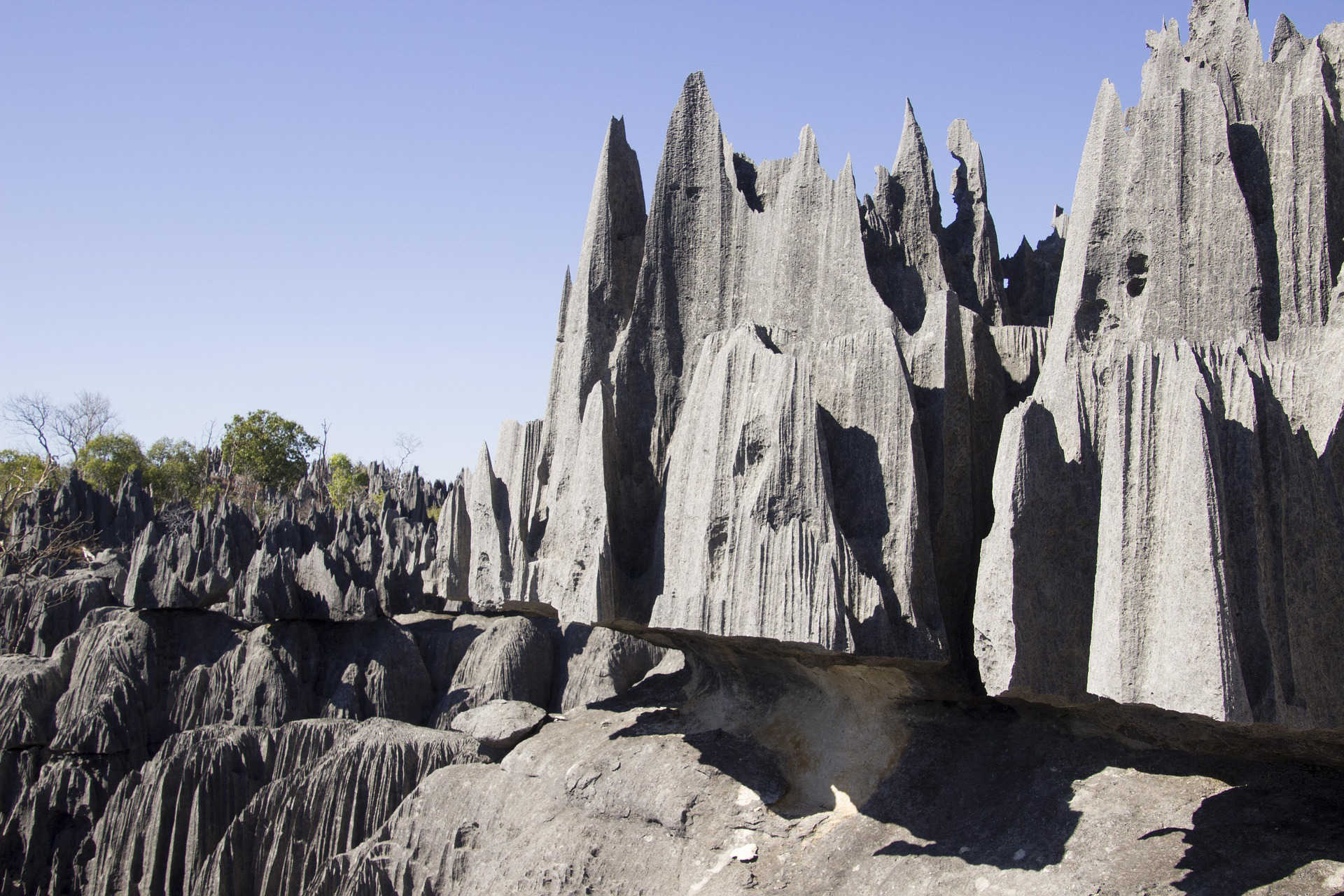
After breakfast, we visit the impressive Great Tsingy of the Tsingy de Bemaraha*, a UNESCO World Heritage Site. The peaks here rise up to 50 metres high. This unique karst landscape is formed by closely spaced limestone needles that create a stone forest, known as tsingy. The 72,300-hectare reserve borders the Manambolo River to the south, and cliffs up to 400 metres high to the east. With annual rainfall of about 1,000 mm, the gorges at the feet of the Tsingys are extremely humid, while the karst areas have more savannah-like conditions. Deeper areas include lakes and mangroves. The park is home to 650 plant species, most of which are endemic. The diverse habitats support a wide range of animal species, including predators like the fossa and ring-tailed mongoose, various lemur species (such as sifakas, red lemurs, eastern bamboo lemurs, aye-aye, and grey mouse lemurs), nearly a hundred bird species (including the Madagascan sea eagle), and numerous species of bats, amphibians, and reptiles (including leaf-tailed geckos and stump-tailed chameleons). The limestone cliffs were submerged underwater for millions of years before being eroded by rain and weather, forming these striking limestone peaks. The guided hike, which lasts about three to five hours, is quite strenuous, as it involves rough and smooth terrain, both uphill and downhill. We climb ladders and wear a safety harness on some sections. This long tour in often very hot weather requires stamina, fitness, and surefootedness. (B)
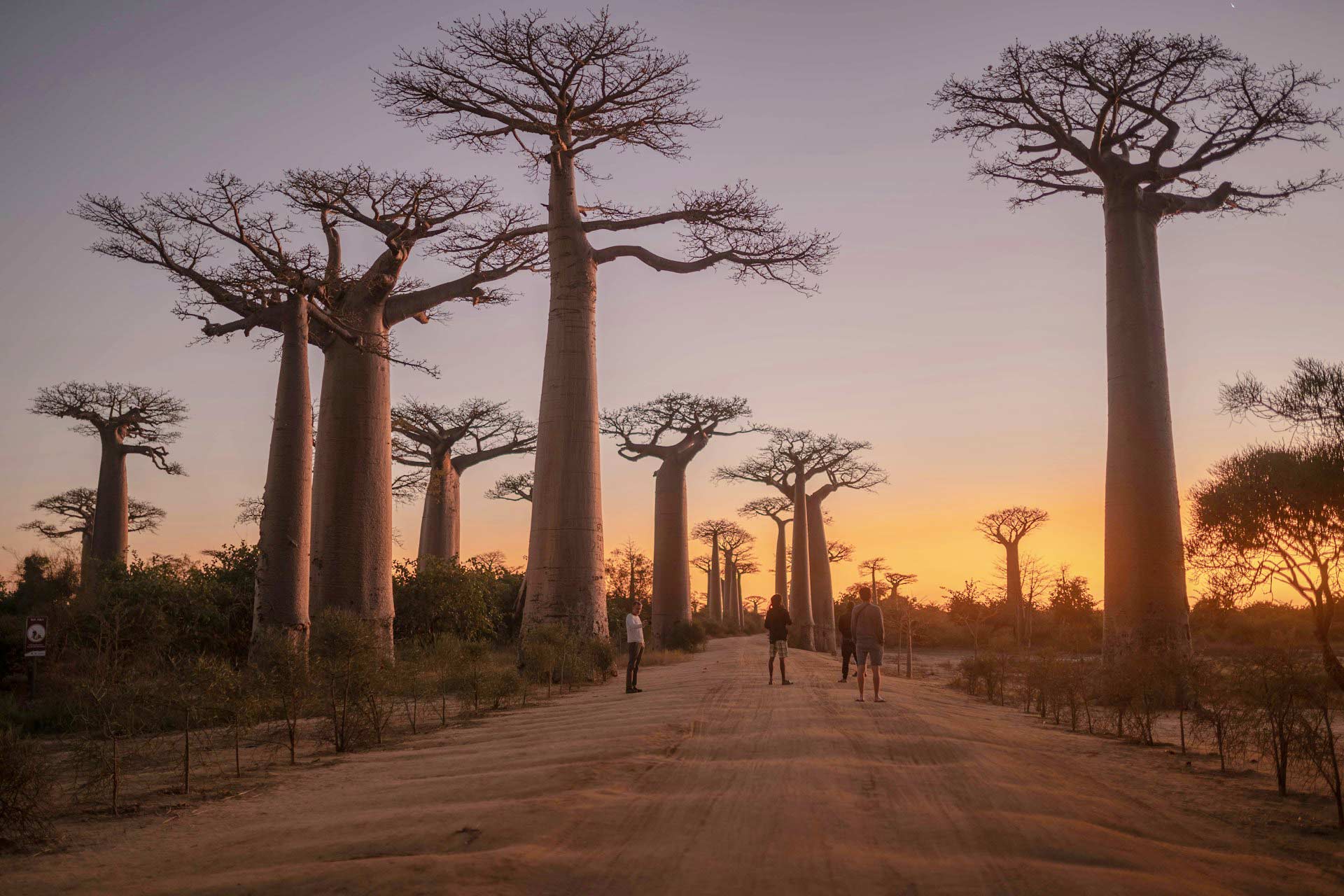
After breakfast, we depart for Morondava on a long day of about nine hours, first taking the local ferry across the Manambolo River, then continuing to Belo-sur-Tsiribihina. From there, we cross the Tsiribihina River by ferry, and then drive through the Baobab Avenue. If timing permits, we will experience the sunset there, a magical moment and photographic highlight, likely shared with many other visitors. Afterward, we drive for about half an hour to reach Morondava.
Overnight: Palissandre Cote Ouest, Morondava (1 night) (B)

After breakfast, we transfer to the airport for our return flight to the capital. Upon arrival, we will be greeted at the airport and transferred to the hotel. The rest of the day is free to relax or explore at our leisure.
Overnight: Relais des Plateaux, Antananarivo (1 night) (B)
After breakfast, we check out of the hotel by 10:00 AM and transfer to Ivato International Airport in time for our departure flight. (B)
Departure Dates & Prices
| 2027 | Per Person on Twin Sharing |
Single Room Supplement |
|---|---|---|
| Departure(s) | ||
| October 4–22 | US$ 9343 | US$ 1876 |
| 2027 | Per Person on Twin Sharing |
Single Room Supplement |
|---|---|---|
| Departure(s) | ||
| October 4–22 | CA$ 13445 | CA$ 2700 |
| Within tour flights | Per Person |
|---|---|
| Tuléar/Tana/Fort Dauphin/Tana/Morondava/Tana in Economy Class (subject to change and availability until ticketed) |
US$ 2154
CA$ 3100
|
Notes
Inclusions
Participants
This tour operates on a minimum of two participants.
Customised Itinerary
If you would like to have a tour on dates other than the above ones or with a customised itinerary, please contact Bestway Tours & Safaris and we will be happy to work out an exclusive program for you.
Recommended Trips


Sign up for our Bestway Club newsletter and be the first to know about special discounts, new tours and travel updates!


